
«Segmentation fault» means that you tried to access memory that you do not have access to.
The first problem is with your arguments of main. The main function should be int main(int argc, char *argv[]), and you should check that argc is at least 2 before accessing argv[1].
Also, since you’re passing in a float to printf (which, by the way, gets converted to a double when passing to printf), you should use the %f format specifier. The %s format specifier is for strings (''-terminated character arrays).
In Linux, the error “segmentation fault (core dumped)” comes across during the execution of the script file (C, C++, Python, Java) from the terminal. The core dump is when a code performs read and write operations on a free memory location.
This article will provide multiple solutions to the above-stated “segmentation fault (core dumped)” error. The supported content of this guideline is as follows:
- Reason: Attempting the Non-Existing Memory
- Solution 1: Remove the Lock File
- Solution 2: Kill the Specific Process
Reason: Attempting the Non-Existing Memory
The main cause of this error is that you are trying to access a specific portion of memory that does not exist. For instance, when users try to read or write the elements of a non-existent array, do not define the pointer before using it or use a memory address with the same variable value. Therefore, the particular program will crash and display the “segmentation fault” error when executing the file:

The next sections contain several solutions to encounter the above error.
Solution 1: Remove the Lock File
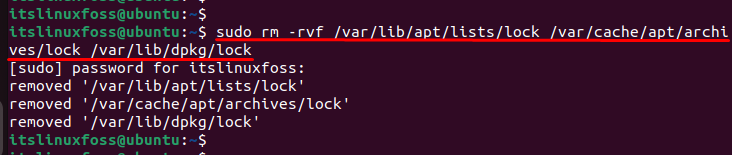
During the execution of a program, locked files are created to make the script files executable. To resolve the error, one of the solutions is to remove the lock file that attempts the non-existent memory. For removing these files, the “rm” command is used to delete the lock files:
$ sudo rm -rvf /var/lib/apt/lists/lock /var/cache/apt/archives/lock /var/lib/dpkg/lock
Let’s head over to another solution.
Solution 2: Kill the Specific Process
Users can consider another solution to resolve errors by killing the specific process. First, locate the process id stored in the “/var/lib/dpkg/lock” directory:
$ sudo lsof /var/lib/dpkg/lock
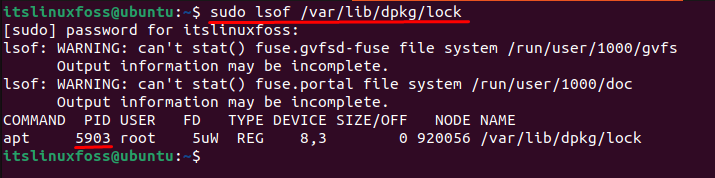
After identifying the specific process id, you can go to terminate the process. For this, the “kill” command is utilized with a “-9” signal that forcefully terminates the running process “5903”:

You can verify that the “kill” command terminates the specific process via “5903” id.
Conclusion
In Linux, the error “segmentation fault (core dumped)” occurs when the process requires additional memory that the operating system does not permit access. It can be resolved by removing the “lock” files through the “rm” command, clearing the cache repository, or killing the process via “process id”. This article has explained all possible solutions to encounter the error mentioned above.
What does it mean?
See AU: What is a segmentation fault? post and also this post which have some examples how reproduce it, SO: What is segmentation fault?.
The simplest description I can come with (may be not the perfect):
The program tried to access a memory area out side its own section. Operating system blocks it.
Some cases: Reading value with uninitialized pointer, Going out of range in an array, Function call (when backward compatibility not maintained), …
However, it is not always easy find the cause with large programs or those which relay on other project lib’s. And most of the cases end up with a bug report, either for target program or one of its dependencies (either upstream project or downstream distribution package).
How can I resolve this issue?
-
Fire a bug report
If you didn’t make any custom configuration/setup and you all updates installed. fire a bug report, see How do I report a bug?
If open source supported by Ubuntu use
ubuntu-bug(apport-bug). For 3rd party closed source, check their help pages how to report bugs and collect related data. -
Take initiative to debug
If you you have even a little programming background, it is recommended that you try your best to resolve it yourself. There many bug reports out there inactive for years. At least, you may be able to collect enough debug data that help resolve the issue when reporting it.
That’s means that you are breaking the user abstraction level and opening the black box! (FLOSS actually has transparent box).
Some Useful Tools for Debugging
Some … I mean there are many other useful tools out there that you gonna find when you dig in more.
-
apport-buglogs / core dump / backtraceIf you don’t have an error message before segmentation fault. Run it with
--saveoption and look for back-trace log:apport-bug program-cmd --save bug-report_output.txt -
gdbbacktrace / debuging source codeIf it didn’t work, use
gdb:$ gdb program-cmd (gdb) run (gdb) backtraceIf you get any error message, check the web, launchpad and in upstream project bug tracker if there any similar cases.
For some advanced users or who are following a c/c++ learning path, they could download the corresponding
-dbgsymbols packages. Then you can usegdbto trace program flow through the source and get the exact function/instruction that raise the runtime error.For Ubuntu(Debian) based distributions, source code of a package can be downloaded using:
apt-get source <package-name> -
stracesystem call tracingAnother tool that may help is
strace, I like it. It’s really a powerful tool.It presents itself:
In the simplest case
straceruns the specified command until it exits. It intercepts and records the system calls which are called by a
process and the signals which are received by a process. The name of each system call, its arguments and its return value are printed on
standard error or to the file specified with the -o option.straceis a useful diagnostic, instructional, and debugging tool. System administrators, diagnosticians and trouble-shooters will find it
invaluable for solving problems with programs for which the source is not readily available since they do not need to be recompiled in
order to trace them. Students, hackers and the overly-curious will find that a great deal can be learned about a system and its system
calls by tracing even ordinary programs. And programmers will find that since system calls and signals are events that happen at the
user/kernel interface, a close examination of this boundary is very useful for bug isolation, sanity checking and attempting to capture
race conditions.Source:
man strace -
ltracedynamic library call tracingltraceis a program that simply runs the specified command until
it
exits. It intercepts and records the dynamic library calls which are
called by the executed process and the signals which are received by
that process. It can also intercept and print the system calls exe‐
cuted by the program.Its use is very similar to
strace(1).Source:
man ltrace
The core file is normally called core and is located in the current working directory of the process. However, there is a long list of reasons why a core file would not be generated, and it may be located somewhere else entirely, under a different name. See the core.5 man page for details:
DESCRIPTION
The default action of certain signals is to cause a process to
terminate and produce a core dump file, a disk file containing an
image of the process’s memory at the time of termination. This image
can be used in a debugger (e.g., gdb(1)) to inspect the state of the
program at the time that it terminated. A list of the signals which
cause a process to dump core can be found in signal(7).…
There are various circumstances in which a core dump file is not produced:
   *  The process does not have permission to write the core file.  (By
      default, the core file is called core or core.pid, where pid is
      the ID of the process that dumped core, and is created in the
      current working directory.  See below for details on naming.)
      Writing the core file will fail if the directory in which it is to
      be created is nonwritable, or if a file with the same name exists
      and is not writable or is not a regular file (e.g., it is a
      directory or a symbolic link).
   *  A (writable, regular) file with the same name as would be used for
      the core dump already exists, but there is more than one hard link
      to that file.
   *  The filesystem where the core dump file would be created is full;
      or has run out of inodes; or is mounted read-only; or the user has
      reached their quota for the filesystem.
   *  The directory in which the core dump file is to be created does
      not exist.
   *  The RLIMIT_CORE (core file size) or RLIMIT_FSIZE (file size)
      resource limits for the process are set to zero; see getrlimit(2)
      and the documentation of the shell's ulimit command (limit in
      csh(1)).
   *  The binary being executed by the process does not have read
      permission enabled.
   *  The process is executing a set-user-ID (set-group-ID) program that
      is owned by a user (group) other than the real user (group) ID of
      the process, or the process is executing a program that has file
      capabilities (see capabilities(7)).  (However, see the description
      of the prctl(2) PR_SET_DUMPABLE operation, and the description of
      the /proc/sys/fs/suid_dumpable file in proc(5).)
   *  (Since Linux 3.7) The kernel was configured without the
      CONFIG_COREDUMP option.
In addition, a core dump may exclude part of the address space of the
process if the madvise(2) MADV_DONTDUMP flag was employed.Naming of core dump files
By default, a core dump file is named core, but the
/proc/sys/kernel/core_pattern file (since Linux 2.6 and 2.4.21) can
be set to define a template that is used to name core dump files.
The template can contain % specifiers which are substituted by the
following values when a core file is created:%% a single % character %c core file size soft resource limit of crashing process (since Linux 2.6.24) %d dump mode—same as value returned by prctl(2) PR_GET_DUMPABLE (since Linux 3.7) %e executable filename (without path prefix) %E pathname of executable, with slashes ('/') replaced by exclamation marks ('!') (since Linux 3.0). %g (numeric) real GID of dumped process %h hostname (same as nodename returned by uname(2)) %i TID of thread that triggered core dump, as seen in the PID namespace in which the thread resides (since Linux 3.18) %I TID of thread that triggered core dump, as seen in the initial PID namespace (since Linux 3.18) %p PID of dumped process, as seen in the PID namespace in which the process resides %P PID of dumped process, as seen in the initial PID namespace (since Linux 3.12) %s number of signal causing dump %t time of dump, expressed as seconds since the Epoch, 1970-01-01 00:00:00 +0000 (UTC) %u (numeric) real UID of dumped process
Programming languages like C and C++ manage the memory in a more direct way than other programming languages like Java, C#, Python, etc. When an application tries to access the memory area that it does not belong to it Segmentation Fault occurs. Generally, the segmentation fault resulted in the core being dumped which is saving the error memory area into a file for later investigation. There are different reasons for the “Segmentation Fault”/”Core Dumped” error like below.
- Modifying String Literal
- Accessing Freed Address
- Accessing Out Of Array Index Bounds
- Improper useof scanf() Function
- Stackoverflow
- Dereferencing Uninitialized Pointer
Modifying String Literal
String literals are stored in a read-only part of the application. String literals can not be edited as they are located in the read-only part of memory. When the string literal is tried to be changed the segmentation fault occurs and the core is dumped with the Abnormal termination of program .
int main()
{
   char *s;

   /* Stored in read only part of application memory */
   s = "wt";

   /* Problem: trying to modify read only memory */
   *(s+1) = 'x';

   return 0;
}
Accessing Freed Address
Pointers are used to allocated memory parts with memory addresses. After usage, the memory areas or addresses are freed and the freed address range can not be used. If the application tries to access the free address locations the “core dump” error occurs.
int main()
{
   char* s= (int*) malloc(8*sizeof(int));

   *s = 10;

   //s memory area is freed
   free(s);

   //Try to access free memory are
   *s = 20;

   return 0;
}
Accessing Out Of Array Index Bounds
C and C++ programming languages provide arrays in order to store multiple characters and values inside a single variable. The size of the arrays should be set during initialization and the memory area is allocated according to its size. If the application tries to access of range memory area of the array the “core dump” error occurs.
int main()
{
   char s[3]="abc";

   s[5]="d";

   return 0;
}
Improper useof scanf() Function
The scanf() function is used to read user input from the standard input interactively. The scanf() function requires the memory address of a variable in order to store read value If the address is not provided properly or read-only.
int main()
{
   char s[3];

   scanf("%s",&s+1)

   return 0;
}
StackOverflow
Every application has a limited memory area called the stack. The stack area is used to store data temporarily during the execution of the application when functions are called. When the stack area is filled and there is no free area the StackOverflow occurs. The stack overflow generally occurs in error-prone algorithms like using recursive functions infinitely.
int main()
{
    rec();
}

int rec()
{
   int a = 5;

   rec();
}
Dereferencing Uninitialized Pointer
Pointers are used to point to specific memory addresses. In order to use a pointer, it should be initialized before accessing or dereferencing it. Without initialization, the pointer does not point to any memory area or data which can not be used.
int main()
{
   int* a;

   printf("%d",*a);

   return 0;
}